

How Much Do Estate Auctioneers Charge
 Nitesh Singh
September 2, 2026
Nitesh Singh
September 2, 2026





Estate auctioneers typically charge 15-35% commission on what your items sell for. But the actual cost depends on what’s included, where you are, and what you’re selling. Understanding these fees upfront helps you compare auctioneers fairly and know what you’ll actually take home.
How Much Will You Actually Pay?
Estate auctioneers charge in several ways. The main fee is commission, which ranges from 15% on high-value items to 35% on smaller household goods. On top of that, you might pay extra for photography, cleaning, insurance, or shipping. Some auctioneers include these in their commission. Others charge separately.
Here’s what matters: ask for a written breakdown before you commit. Don’t just look at the commission percentage. Look at the total cost and what’s included.
Example:
- Your estate sells for $50,000
- Auctioneer commission: 20% = $10,000
- Photography fee: $200
- Cleaning fee: $300
- Your take-home: $39,500
That’s real money. Knowing the fees ahead of time prevents surprises.
Why Estate Auction Fees Vary So Much
Commission rates aren’t fixed. They depend on several factors:
Item type matters. Fine art, jewelry, and antiques command lower commissions (15-25%) because they’re easier to sell and attract serious buyers. General household items cost more to sell (25-35%) because the auctioneer needs to spend more time marketing and sorting.
Item value matters. A $100,000 estate might get a 15% commission. A $10,000 estate might pay 30%. Higher-value sales are worth the auctioneer’s time at lower percentages.
What’s included matters. Some auctioneers include photography, insurance, and marketing in their commission. Others charge each separately. A 20% commission with everything included might actually be cheaper than a 18% commission where you pay $500 extra for photos and $300 for cleaning.
Your location matters. Major auction cities (New York, Los Angeles, Chicago) often have lower commissions because there’s more competition. Rural areas might charge higher percentages because there are fewer auctioneers.
[PLACEHOLDER: Add real regional pricing examples if you have data. “In the Northeast, typical commissions range from X-X%. In the Midwest, we typically see X-X%.”]
How Estate Auctioneers Charge (The Main Fee Types)

Commission on sales. This is the primary fee. You pay a percentage of what your items sell for. Ranges from 15-35% depending on item type and value.
Buyer’s premium. The auctioneer adds this to the winning bid (usually 10-15%). Buyers pay it, not you. It increases the final sale price, which can actually help you.
Listing fees. Some auctioneers charge $50-$500 to catalog and list your items online.
Photography fees. Professional photos cost $200-$500. Some auctioneers include this in commission. Others charge separately.
Cleaning fees. If items need prep or cleaning before sale, expect $200-$1,000 depending on the estate size.
Buyer-back fees. Items that don’t sell might get charged a “buyer-back” fee ($10-$50 per item) if the auctioneer has to return them to you.
Insurance. Temporary insurance during the auction runs $100-$500.
[PLACEHOLDER: Real fee breakdown from your platform or typical pricing]
Estate Auction Fees vs Selling Private/Online
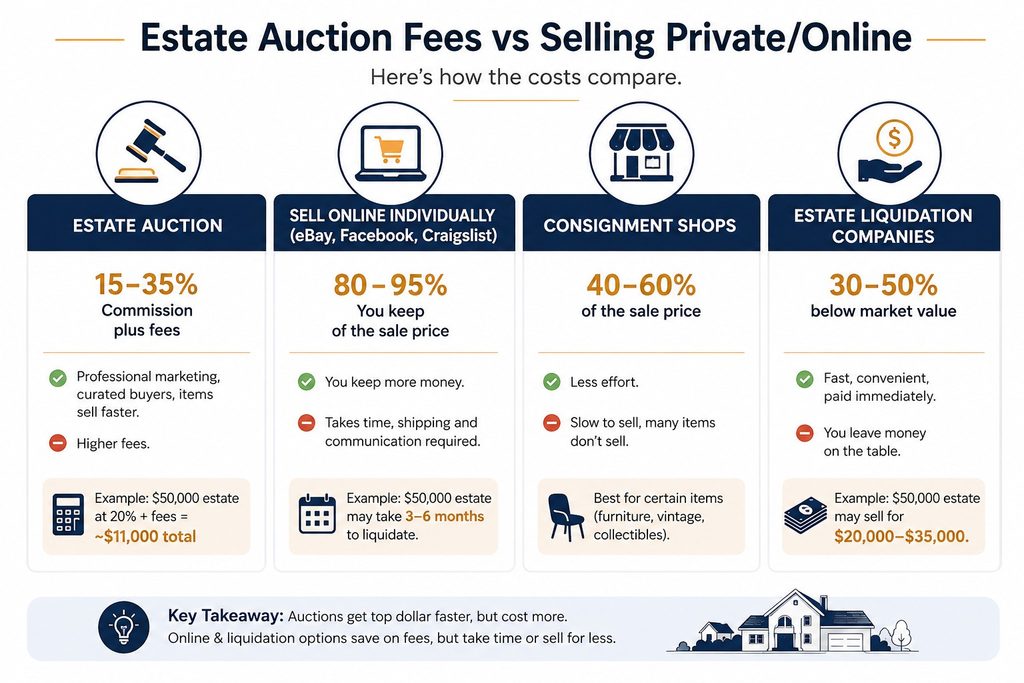
Estate auctions aren’t the only way to sell. Here’s how the costs compare.
Estate auction: 15-35% commission plus fees
You get professional marketing, a curated audience of serious buyers, and items sell faster. Downside: higher fees. If your estate sells for $50,000 at 20% commission, you pay $10,000. Add photography, cleaning, and other fees, and you might pay $11,000 total.
Selling items individually online (eBay, Facebook Marketplace, Craigslist)
You keep 80-95% of the sale price. eBay takes 12-15%, Facebook and Craigslist are free. Upside: you keep more money. Downside: it takes weeks or months, requires constant communication with buyers, shipping costs eat into profit, and you handle logistics yourself. A $50,000 estate could take 3-6 months to liquidate this way.
Consignment shops
They take 40-60% of the sale price. You keep 40-60%. Slow to sell (items sit on shelves), and you often have to pick up unsold items. Only works for certain item types (furniture, vintage clothes, collectibles). A $50,000 estate won’t work here.
Estate liquidation companies
They buy your entire estate outright at 30-50% below market value. You get paid immediately, no waiting. Easiest but you leave the most money on the table. A $50,000 estate might sell for $20,000-$35,000.
The real comparison:
[PLACEHOLDER: Add your real-world example or data. “One seller we worked with had a $75,000 estate. At auction with our 20% commission, they netted $60,000 after all fees. If they’d sold individually online, they estimated 6 months of work and would have netted $55,000 after shipping and time.”]
Bottom line: Estate auctions cost more upfront but get items sold faster and for better prices. If you value your time and want certainty, the auction fees are worth it. If you have months to spare and want to maximize every dollar, selling privately takes more effort but leaves more in your pocket.
What’s Included vs What Costs Extra
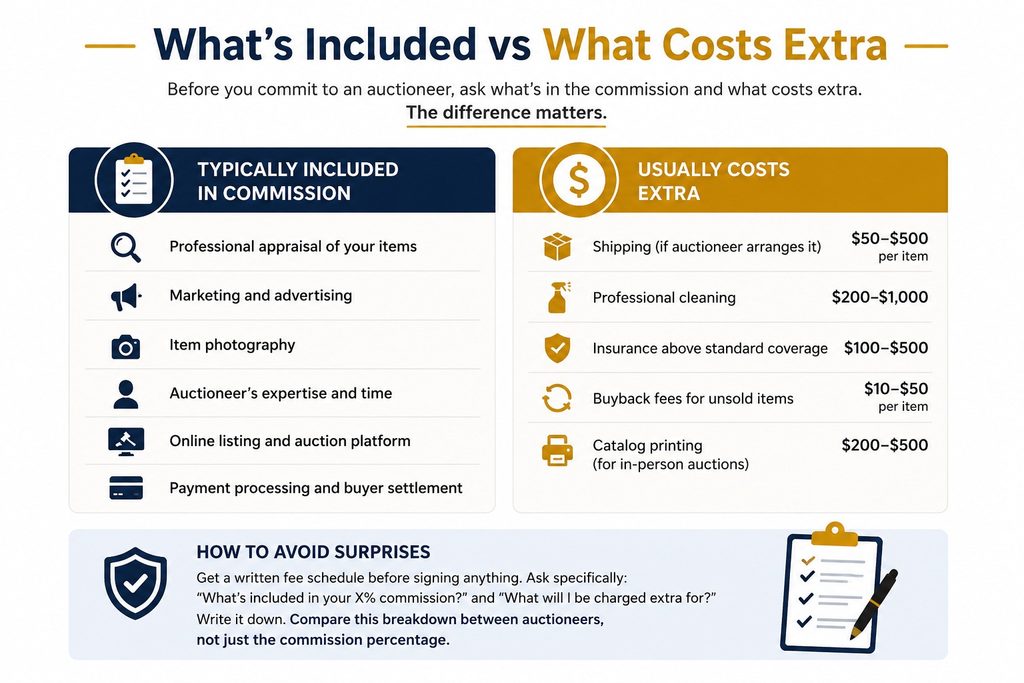
Before you commit to an auctioneer, ask what’s in the commission and what costs extra. The difference matters.
Typically included in commission:
- Professional appraisal of your items
- Marketing and advertising
- Item photography
- Auctioneer’s expertise and time
- Online listing and auction platform
- Payment processing and buyer settlement
Usually costs extra:
- Shipping (if auctioneer arranges it): $50-$500 per item
- Professional cleaning: $200-$1,000
- Insurance above standard coverage: $100-$500
- Buyback fees for unsold items: $10-$50 per item
- Catalog printing (for in-person auctions): $200-$500
How to avoid surprises:
Get a written fee schedule before signing anything. Ask specifically: “What’s included in your X% commission?” and “What will I be charged extra for?” Write it down. Compare this breakdown between auctioneers, not just the commission percentage.
[PLACEHOLDER: Add a real example from your platform. “Our clients typically see an average of $X in additional fees beyond commission” or “Most of our estates pay between $500-$2,000 in extra fees depending on the service level chosen.”]
A 20% commission with everything included might actually cost you less than an 18% commission where you pay $600 in extras.
How to Compare Auctioneers and Avoid Overpaying
Don’t pick the first auctioneer you call. Get estimates from at least three. Here’s what to compare.
Get it in writing. Ask each auctioneer for a written fee breakdown. Commission percentage, listing fees, photography costs, cleaning, insurance, buyback fees. Everything. You can’t compare if you don’t see the full picture.
Understand buyer’s premium. This fee goes to the auctioneer, not you. But it increases the final sale price, which can help you. A 10% buyer’s premium might mean items sell for 5-10% higher prices overall. That’s not a bad thing.
Ask about unsold items. What happens if something doesn’t sell? Do they return it? Charge a buyback fee? Store it? This matters because it affects your bottom line and logistics.
Verify credentials. Check if they’re licensed and bonded in your state. This protects you if something goes wrong. Ask for references from other sellers and actually call them.
Compare total cost, not just commission. Auctioneer A: 20% commission, no extra fees. Auctioneer B: 18% commission, $600 in extras. Auctioneer A costs you less. Do the math.
Ask about their sales history. What’s the average sale price they get for estates like yours? What’s their sell-through rate (percentage of items that actually sell)? A lower commission from an auctioneer who gets lower prices isn’t a deal.
[PLACEHOLDER: Add your competitive advantage. “Our clients typically see X% higher sale prices compared to other local auctioneers” or “We have a Y% sell-through rate” or similar proof point.]
Conclusion
Estate auctioneers charge 15-35% commission, plus optional fees for photography, cleaning, insurance, and other services. The total cost depends on what’s included, your location, item type, and how much you negotiate.
The key is getting a written fee breakdown before you sign anything. Compare at least three auctioneers. Don’t just look at commission percentage. Look at total cost, what’s included, their track record with estates like yours, and what happens to unsold items.
Higher upfront fees often mean better prices for your items and faster sales. If you value your time and want certainty, auction fees are usually worth it. If you have months to spend selling privately, you might keep more money, but the work is on you.
[PLACEHOLDER: Add a next step. “Ready to get started? Request an appraisal from [your company]” OR “Want to learn more about estate auctions? Read our guide on [link to your estate auction post].”]


Nitesh Singh is a software veteran and the Founder of Ultimate Auction. With 16+ years of experience in web development, he specializes in building high-performance auction tools for the WordPress community. Connect with Nitesh on LinkedIn or follow his latest auction strategy guides here.
More articles by Nitesh SinghRelated Post

How to Run a Sealed Bid Auction: Step-by-Step Guide
Running a sealed bid auction well comes down to five things: setting a clear submission deadline, writing bid instructions nobody can misread, collecting bids without letting anyone see a competitor’s number, opening them at a set time, and communicating the result fast. Get those five right and the format runs itself. Get any one wrong […]
Read More
What Is an Estate Auction? How They Work and How to Buy at One
An estate auction sells the entire contents of a household to the highest bidder, usually after someone has died, moved into assisted living, or decided to downsize. Everything goes: the furniture, the jewelry, the tools in the garage, the boxes of things nobody has opened in years. If you’re wondering what actually happens at one, […]
Read More
Ultimate Auction Pro vs YITH WooCommerce Auctions: Which One Actually Wins the Bid?
I’ve spent the last decade helping shop owners move away from the “fixed price” grind. Whether it’s a non-profit trying to squeeze every dollar out of a charity gala or a specialized collector looking to build the next eBay, the question always lands on my desk: “Which auction plugin won’t break when 50 people bid […]
Read More