

Category: Silent Auction




- Why do silent auctions work for art galleries?
- How do you set the starting bid for artwork?
- Should you put gift cards in an art auction?
- Are silent auction purchases tax deductible?
- Is a silent auction legal?
- How do you run a silent art auction online?
- Where do you get artwork for a silent auction?
- How do you split the sale with the artist?
- What happens to pieces that don’t sell?
- What are the best tips for running a silent art auction?
- What should you do next?
A silent auction for an art gallery lets visitors bid on artwork by writing offers on a sheet beside each piece, or by placing bids online. There’s no auctioneer and no paddles. When the clock runs out, the highest bid wins. If you run a gallery, or you’re planning a fundraiser inside one, this guide shows you how to price the work, set up the room, handle the tax and legal questions, and take bids online. [PLACEHOLDER: one real line of experience, e.g. "We've seen galleries close X pieces in one evening using Ultimate Auction."]
A silent auction for an art gallery is a timed sale where visitors place written or digital bids on displayed artwork without a live auctioneer. Each piece has a starting bid and a bid sheet or online page. When bidding closes, the highest bidder wins and pays the gallery, which then settles with the artist or the cause. In-person events usually run two to four hours, and online ones run three to seven days.
Why do silent auctions work for art galleries?
Because buyers get time with the work. Nobody has to decide in front of a crowd, so people walk the room, come back to a piece, and bid when they’re ready.
That pace suits art. A painting that looks fine from the doorway can look very different after ten minutes of standing in front of it. Quiet bidding also gives you a second effect: when a guest sees someone else’s name or paddle number on the sheet beside their favorite piece, they often come back and bid again.
First-time buyers are the biggest win. Most people won’t spend several thousand dollars on a private sale with a gallery they’ve just met. Put the same people in a relaxed room with a glass of wine and a $300 opening bid, and they’ll try. The guest who wins one small print tonight is on your mailing list tomorrow, and that’s how a crowd turns into collectors.
How do you set the starting bid for artwork?
Start between 30% and 50% of the piece’s fair market value. For a $2,000 painting, that’s an opening bid of $600 to $1,000. It’s a rule of thumb, not a law, so adjust it by the kind of work.
Go closer to 30% for prints, emerging artists, and smaller pieces. A low opening bid gets the first name on the sheet, and one name invites the next. Go closer to 50% for established artists or one-of-a-kind works, where a very low start can make the piece look undervalued.
Where does fair market value come from? Use the gallery’s retail price, recent sales of the same artist’s work, or a written appraisal for higher-value pieces. Don’t guess. The number also goes on the receipt later, so it has to hold up. [PLACEHOLDER: add one real example, e.g. "At our [event], a $X piece opened at $Y and closed at $Z."]
Should you set a reserve? If you’re a commercial gallery selling work for artists, yes. A reserve is the lowest price you’ll accept, and the artist should agree to it before the event. If it’s a charity night with donated work, most organizers skip it so every piece can sell.
How big should bid increments be? Match them to the price. Here’s a sample you can adapt:
| Current bid | Minimum raise |
|---|---|
| Under $500 | $25 |
| $500 to $2,000 | $50 to $100 |
| Over $2,000 | $100 to $250 |
Too small and bidding crawls. Too big and people stop bidding. Print the starting bid and the increment on every bid sheet or online listing so nobody has to ask.
Should you put gift cards in an art auction?

Yes, in small numbers. A dinner for two or a spa day gives guests who aren’t ready to bid on a painting something they can bid on, and that keeps them at the table longer.
Keep them to a few items next to the art, not mixed in with it. And dress them up. A plain envelope gets ignored. Set a spa card on a folded towel with a candle, or a restaurant voucher beside a wine glass. Put the value, expiry date, and what’s included on the card beside it.
One caution: if gift cards become half your table, the event stops feeling like an art night. Keep the art as the main draw.
Are silent auction purchases tax deductible?
Usually only part of them, and only if the seller is a registered charity. A winning bidder can deduct the amount they pay above the artwork’s fair market value. They can’t deduct the value of the artwork itself, because they received it.
Here’s an example. A painting has a fair market value of $1,200, and a bidder wins it at $1,500. The extra $300 can count as a charitable gift, provided the bidder was really giving it as a gift and the charity gives them a proper receipt. If your gallery is a commercial business and not a nonprofit, the buyer gets no deduction.
What you need to do as the organizer:
- List the fair market value on every item before the event.
- Issue a receipt that shows the winning bid, the fair market value, and the difference.
- In the US, if a bidder pays more than $75 and part of it is a gift, the charity must give a written statement with a good-faith estimate of what the buyer received. IRS Publication 1771 covers the wording.
[PLACEHOLDER: verify against current IRS guidance before publishing]
What about the people who donate work? Rules for donors are stricter than most expect. In the US, an artist who donates their own piece can generally deduct only the cost of materials, not the retail price. A collector donating a piece they bought is limited too when the charity sells it at auction. [PLACEHOLDER: verify with a tax professional] Tell donors up front, and suggest they check with their own tax adviser.
Tax rules differ by country and state, so treat this as a general guide and not as tax advice.
Is a silent auction legal?
Yes. A silent auction is an ordinary sale to the highest bidder. It isn’t gambling, because the winner is decided by the bids and not by chance, which is what separates it from a raffle.
What varies is the paperwork around it. Before you advertise, check these four things:
- Charity registration. If it’s a fundraiser, some US states and cities require charities to register before they ask for donations or run an event.
- Auctioneer license. Most places don’t require one for silent auctions, but a few regions have older rules for art sales above a set value. Call your local licensing office to confirm.
- Sales tax. You may need to collect it on items sold, unless your organization has an exemption.
- Alcohol. If you’re pouring wine, the venue or your gallery needs the right license or permit.
[PLACEHOLDER: add one real detail, e.g. what you or a customer had to file for an event, and in which state or country.]
Rules depend on where you are, so ask a local accountant or lawyer who handles nonprofit events before the date is set.
How do you run a silent art auction online?
Use auction software that lets you list each piece with photos and set a start and end time. Bidders place bids from their phones, and the software tracks who’s winning and collects payment when bidding closes.
For an art auction, the listing page does the job of standing in front of the painting. Set up each one with:
- Several photos: the full piece, a close-up of the brushwork or texture, and one in a room or frame for scale
- Dimensions, medium, and framing details
- A short note on the artist, with a name and a line of backstory
- Condition notes, including any marks or repairs
- The starting bid, the increment, and the closing time
- Pickup and shipping details, including who pays for crating on larger pieces
Let bidders set a maximum bid and get an alert when someone outbids them, so they don’t have to keep checking. If you’re running an in-person event too, put a QR code on each wall label that opens that piece’s page, so people in the room can bid from their phones.
Open the catalog early. Publish the pieces two to three days before bidding starts. Post one piece a day on Instagram with the artist’s story, and link to its page. People browse, pick favorites, and arrive ready to bid. [PLACEHOLDER: add a screenshot of your Ultimate Auction catalog or a bid page, and one real result, e.g. how many bids the first online event drew.]
For the basics of how bidding works, see how a silent auction works.
Build a beautiful auction site for your art gallery
Let your viewers place bids and increase your market presence today.

Where do you get artwork for a silent auction?
Ask artists and collectors first. Gallery artists, local artists, and patrons who own work are the most likely to say yes, and the pieces will suit your audience.
Good places to start:
- Artists who have shown with you. Many will give a piece or a print to support the event, especially if their name gets billing.
- Patrons and collectors. Someone on your mailing list may have a piece they’d happily see go to a good home.
- Local art schools and studios. Faculty and graduating students often welcome the exposure.
- Board members with connections. That one member who knows every collector in town? Ask them.
- Local businesses, for the gift cards and experiences mentioned above.
Be specific when you ask. “Would you donate a framed print, around 40 by 50 cm, for our October event?” gets a better answer than “Got anything we can use?” If the first person says no, ask again next season. Repeated, polite asking is how most donor lists get built.
Then make it easy to say yes. Offer a credit in the catalog, the artist’s name on the wall label, and a line in your event emails. Put the terms in writing before the event: who owns the work, the reserve (if any), who pays for framing and shipping, and what happens if it doesn’t sell. [PLACEHOLDER: add one real example, e.g. how many pieces you or a customer collected for a first event, and where they came from.]
How do you split the sale with the artist?
It depends on whether the event is a fundraiser or a sales event.
At a charity auction, the artist usually donates the piece and the full winning bid goes to the cause. At a sales event for a commercial gallery, the gallery and the artist split the proceeds, and the split is agreed before the work goes on the wall. [PLACEHOLDER: add a typical split that you or your customers use. Don't copy a number you can't back up.]
Special Offer – Limited Time Only!
Rev Up Your Savings: Get 10% off Essential Ultimate Auction Software!
Fill the form and receive directly to your mailbox a discount code.
"*" indicates required fields
What should you do next?
Before you plan anything else, choose five pieces and set a starting bid and a minimum raise for each. If you can fill in those numbers, the rest of the event follows.
Then decide how people will bid. A paper sheet works for a small room. If you want bids from people who can’t attend, or you’re tired of chasing winners and counting sheets, Ultimate Auction gives you real-time bid updates, automatic increments, proxy bidding, timed start and end controls, and a dashboard that shows which pieces are drawing bids. It handles a one-night event and a week-long online sale equally well.
Not sure yet? Open the live demo and set up one artwork as a test listing. It takes a few minutes and shows you how the bidding looks from the buyer’s side.
Easily Manage Silent Auctions for Art Gallery with Our Software
Trusted by thousands of users to take the best deals on their art work. Try the demo today.
Frequently Asked Questions
Whichever applies, send the artist a one-page agreement that covers the split, the reserve price, the closing date, and when they’ll be paid. It takes ten minutes and saves arguments later.
What happens to pieces that don’t sell?
Plan for it. A few pieces at every event get no bids, and that’s normal.
Decide beforehand which of these you’ll do: return the piece to the artist, keep it on the wall for a few more weeks at a fixed price, or offer it to the underbidders at their last bid. Tell the artist which one in the agreement, so nobody is surprised on the night. [PLACEHOLDER: add what you've seen work, e.g. "At our last event, X of Y unsold pieces sold within a week at the reserve price."]
What are the best tips for running a silent art auction?
- Keep the window short. Two to four hours works for an in-person event. Online, three to seven days is enough. Longer than that, and people forget about it.
- Announce the last call. Tell the room, or send an email or text, 30 minutes and then 10 minutes before the close. Most late bidding happens in the final minutes, so don’t skip this one.
- Post your rules where people can see them. No bid retractions, how ties are settled, how and when winners pay, and when they collect their work. Print them on the bid sheet or at the top of the online listing.
- Light and label every piece. One piece, one label, one bid sheet right beside it. Put the artist, title, medium, size, starting bid, and increment on the label. A good light on the work matters more than a fancy table.
- Walk the room. A volunteer who points out the sheets and answers questions turns a wanderer into a bidder.
- How Does a Silent Auction Work?
- What Are the Best Practices for Running a Silent Auction?
- How Do You Run a Silent Auction, Step by Step?
If you’re planning a fundraiser and wondering how a silent auction works, here’s the short version: guests browse donated items, place bids on paper or on their phones, and the highest bidder wins when time runs out. This guide is for nonprofit staff, school committees, and volunteers who want to run one, in person or online. You’ll learn the step-by-step process, what a good setup looks like, and the mistakes that cost organizers money.
How Does a Silent Auction Work?
A silent auction lets guests bid on items without an auctioneer calling out prices. Each item has a bid sheet or an online listing with a starting bid, and guests can bid as many times as they like until the closing time. The highest bidder when bidding closes wins the item and pays the organizer. You can run a silent auction in person, online, or both.
Here’s how it plays out from start to finish:
- Collect items and set starting bids. Donated items usually start at 30 to 50% of fair market value.
- Display each item. In person, that means a table with a bid sheet next to each item. Online, it’s a listing page with photos, a description, and a countdown timer.
- Open bidding. Guests bid anonymously with a bidder number, on the sheet or through a mobile bidding link or QR code. Online platforms send outbid alerts so guests can come back and raise their bid.
- Close bidding. Pick a clear closing time. Announce it ahead of time, and have a volunteer or emcee call out a 15-minute warning at live events.
- Collect payment and hand off items. Winners are notified, pay by card or online checkout, and pick up their items. Online platforms handle receipts and payment tracking automatically.
What Are the Best Practices for Running a Silent Auction?
Most silent auctions that raise good money do the same few things: they promote items early, set a firm closing time, and keep the room easy to move through. Here’s what to get right.
1. Preview your best items before the event
Post photos of your top three or four items in your newsletter and on social media a week or two ahead. Guests start deciding what they want before they arrive, and online bidders can place opening bids right away.
2. Set one firm closing time
Pick a time, announce it everywhere, and stick to it. A deadline gets people to bid now instead of “later.” Check your schedule too, so dinner service or a speech doesn’t pull guests away in the last ten minutes, which is when most bidding happens.
3. Don’t overstock the room
A table crowded with items makes guests browse and leave without bidding. A common rule of thumb is no more than one item for every two guests. If you have extra donations, hold some back for your next event.
4. Keep the room easy to walk through
Leave space between tables so a few people can read a bid sheet without blocking the aisle. Put your most popular tables away from the entrance and the bar. Crowded corners make people give up on bidding.
5. Offer items at different price points
Don’t put only high-value items on display. Mix gift baskets, experiences, and big-ticket items so every guest finds something in their budget. Group items by category or price on separate tables, so guests can find what they’re after quickly.
6. Set starting bids and bid increments
Start each item at a fair price, often well below retail value, and set a clear minimum raise (for example, $5 on items under $100 and $10 above that). Clear increments stop bidding from stalling and keep guests from raising a bid by only a dollar.
Special Offer – Limited Time Only!
Rev Up Your Savings: Get 10% off Essential Ultimate Auction Software!
Fill the form and receive directly to your mailbox a discount code.
"*" indicates required fields
How Do You Run a Silent Auction, Step by Step?
Running a silent auction takes more planning than setting items on tables and waiting for bids. The steps below follow the order most organizers work in, starting with the one that affects your total the most: promotion.
Step 1: How do you promote a silent auction?
Start promoting four to six weeks before the event, and spread the work across email, social media, and your own community. Guests who know what’s on offer arrive ready to bid, and online bidders can start before the doors open.
Here’s what works for each channel:
Email. Send an invitation, then a preview of your top items one to two weeks out, then a last-call email the day before. If your list is large, send donors and past bidders different versions. Past bidders already know how it works, so tell them what’s new this year.
Social media. Post photos of individual items on Facebook, Instagram, and X, one or two a day in the final week. Add a countdown post (“3 days left to bid”) with a link to the auction page. Clear, well-lit photos get more attention than stock images.
Sneak peeks. Share your three or four biggest items early with a photo, a short description, and the starting bid. A 15-second phone video of an experience item (a tour, a class, a weekend stay) tends to draw more interest than text alone.
Your own community. Ask donors, sponsors, and board members to share the auction link with their contacts. A message from a person guests know gets more clicks than a post from the organization. For in-person events, add a QR code to flyers and posters so people can register to bid from their phones.
2. How do you choose a venue for a silent auction?
Pick a room with space for guests to browse without lining up at tables, easy access for everyone, and a spot for food and drinks away from the bidding. If your auction is fully online, skip to Step 3.
Space. Guests need to walk, stop, and read a bid sheet without blocking others. A room that feels slightly too big works better than one that feels full.
Display area. Check how many tables the venue provides and where they can go. Line some along the walls and place a few in the middle so people can circle them.
Accessibility. Look for step-free entry, wide aisles for wheelchairs, tables at a height everyone can reach, and enough parking or a nearby bus or train stop.
Food and drink. Place the bar and food away from the auction tables. Guests who stop to chat next to a bid sheet block the people trying to bid.
Wi-Fi and power. If guests will bid from their phones, test the signal in the room before the event. Weak Wi-Fi in the corner where your best items sit costs you bids.
3. How do you choose the right auction items?
Choose items based on who is coming, not on what’s easiest to collect. A school parent night, a hospital gala, and a church dinner will bid on very different things.
Know your audience. Look at who attended past events. Are they young families, retirees, local business owners? Ask your committee what those groups spend money on, and look at which items sold fastest last time.
Offer a mix. Include a few big-ticket items (a getaway, a piece of art, electronics), a handful of mid-range baskets, and several smaller items so every guest has something in their budget. Wine baskets, restaurant gift cards, spa days, and tickets to local events are reliable sellers.
Choose items people can’t buy in a store. A cooking class with a local chef, a parking spot at the school for a month, or a signed item from someone in your community will draw more interest than a generic gift card. Guests bid higher on things they can’t just order online.
4. How do you display auction items?
Give every item its own space, good light, and a sign next to it. Guests decide in a few seconds whether to stop, so the display has to make that easy.
Use different heights. Put items on risers, boxes covered with a tablecloth, or stacked crates so the back row stays visible. Keep the tallest items at the back.
Light the tables. A dim corner loses bids. Check the lighting with the room set up, and add clip lights or lamps on the darker tables.
Group items. Put related items together (food and wine, kids’ items, experiences) so guests can find what they want. Add simple props like a basket, a ribbon, or a plant to make a gift basket look finished.
Add a sign and a bid sheet to each item. Use an easel or stand with the description, and attach a pen to the bid sheet so guests don’t have to hunt for one. This stops guests from asking volunteers the same questions all evening.
For online auctions, photograph each item in natural light against a plain background, and add two or three angles. A clear photo does the job of the display table.
5. What should an item description include?
A good description tells bidders what they’re getting, what it’s worth, and why their bid matters. Keep it short enough to read in about ten seconds.
Include:
Where the money goes. One line on what the funds support, such as “Every $50 raised buys a week of school supplies for a class.
Get your Car Auction Website Instantly
Sell your car from your own website and earn Buyer’s Premium on it

6. Registration
Although registration is not always required for silent auctions, there are several benefits for both participants and organisers:
Anonymity:
Participants can maintain their anonymity throughout the bidding process by registering. A bidder number is given to each registered participant; they can use this number instead of their names.
Contact Information:
Registration gives organisers access to vital contact details. This can be helpful for post-event communications, such as providing details on successful bids and upcoming events.
Orderly Process:
The bidding process is streamlined and kept organised using bidder numbers. It also lessens the likelihood of misunderstandings or conflicts.
7. Bid Sheets
In a silent auction, the bidding sheets are the hub of activity. They are the primary means by which participants can bid on goods they want. When creating and utilizing bid sheets, keep the following in mind:
Clear Instructions:
Give precise directions on how to fill out the bidding form. Specify the location for writing the bid amount and bidder number. If your product has a “Buy Now” option, explain how to use it.
Buy Now Price:
If there is a “Buy Now” price for an item in your auction, ensure the bidding sheets make it obvious. This eliminates the need for attendees to wait to place a bid and enables them to make an instant purchase.
Volunteer Assistance:
Ensure volunteers are on hand to aid attendees with the bidding sheets or any questions. They can offer advice to participants on proper bid placement.
Organised Placement:
Ensure the bid sheets are arranged so guests can easily find and access them. Group them by item or category for a more organised display.
What Is Silent Auction Software, and Do You Need It?
Silent auction software lets guests browse items, place bids, and pay online instead of on paper bid sheets. You don’t need it for a small in-person event, but it saves a lot of work once you have more than a few dozen items or guests who can’t attend in person.
Here’s what it handles for you:
- Bidding. Guests bid from their phones, and the software tracks the highest bid and sends outbid alerts.
- Hidden bids. In a silent auction, other bidders shouldn’t see the current price. The software hides it for you.
- Closing. Every item closes at the set time, so you don’t need volunteers collecting bid sheets.
- Payment and records. Winners pay online, and you get one list of what sold and who owes what.
What does it look like in practice?
Here’s how silent bidding works in Ultimate Auction Pro Theme.
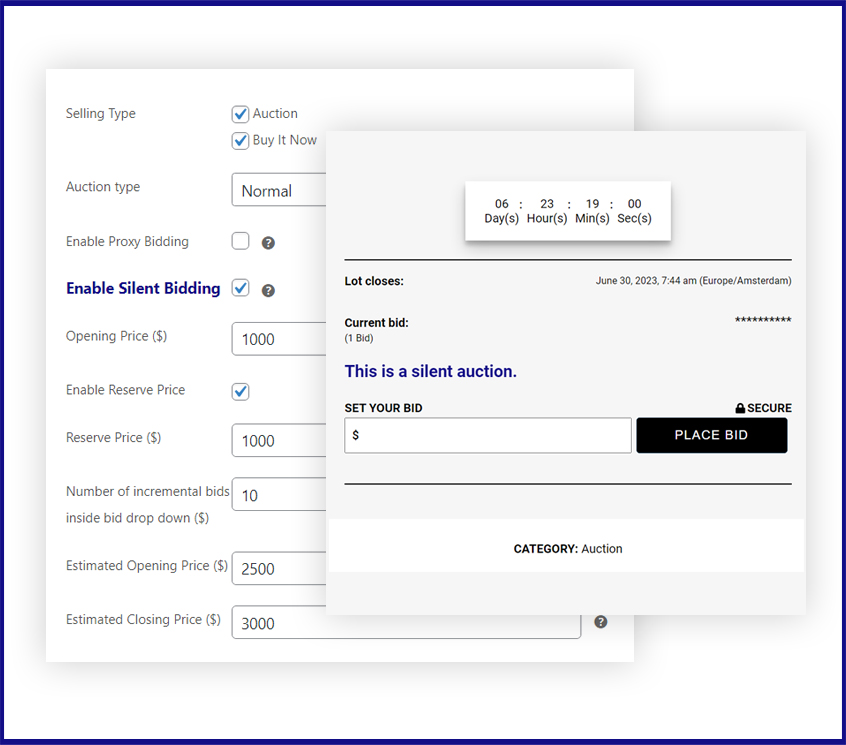
On the left is the admin screen. You tick Enable Silent Bidding, then set the opening price, reserve price, and bid increments. On the right is what bidders see: a countdown timer, the closing time, a hidden current bid, and a Place Bid button.
What to look for when choosing software
- Hidden bids, so it works as a true silent auction
- A reserve price and bid increments you can set per item
- Mobile-friendly bidding, so guests don’t need to install an app
- Secure online payment and receipts
- Outbid alerts by email or text
- Support if something breaks during the event
What Should You Do Next?
Before your next silent auction, pick your closing time and your top five items, then work backward to build your promotion schedule. Those two decisions shape everything else.
If you’d rather run it online, you can see how the silent bidding settings work in Ultimate Auction Pro Theme.
Get your Car Auction Website Instantly
Sell your car from your own website and earn Buyer’s Premium on it
Get your own Auction Today!

Choose Your Plan

Easy Setup

5 Star Support
Welcome to the exciting world of silent auctions! If you’re wondering what is a silent auction, it’s a fundraising event or sales format where bids are placed privately rather than openly. Whether you’re a nonprofit organization raising funds for a charitable cause or an entrepreneur looking to create a unique online marketplace, hosting a silent auction website can be a rewarding venture.In this comprehensive guide, we’ll walk you through the essential steps and considerations to ensure your auction website is a resounding success.
What is a Silent Auction and How does it work?
A silent auction is a fundraising event where items are displayed with bid sheets and bidders submit bids privately instead of calling them out loud. The highest bidder wins each item. Nonprofits use them because they’re less intimidating than live auctions and raise serious money.
How Silent Auctions Work
The in-person format is simple. Items sit on tables with a bid sheet next to each one. The sheet shows the item, its starting bid, and blank lines where bidders write their name and bid amount. Participants walk around, look at items, and write down bids. When the auction closes at a set time, whoever has the highest bid on each sheet wins that item.
Online silent auctions work the same way on a website or app. Bidders log in, browse items, and enter their maximum bid.
Why They Work for Nonprofits
Silent auctions raise money effectively because people bid on items they actually want, and there’s no pressure to bid fast.
They’re also flexible. You can run a silent auction alongside a live auction at a gala, or as a standalone event. Some nonprofits run them for 24+ hours online to reach bidders across a wider area.

Throughout the auction, participants keep a close eye on their desired items, monitoring the bids. The auctioneer or event organizer announces the closing time, giving participants a final opportunity to submit their highest bids.
It is possible to host silent auctions completely over the internet with the help of silent auction software. Rather than checking out an item in a venue, participants can check out auction items online and outbid one another from their desktop, laptop, or mobile. Silent auctions provide a thrilling and engaging experience, combining the excitement of competition with the satisfaction of supporting a worthy cause.
Why Run a Silent Auction?
Silent auctions raise money effectively. Here’s what makes them work.
People bid more freely. Live auctions can feel high-pressure. Silent auctions let people bid at their own pace without feeling rushed or judged. That lower barrier to entry means more bids overall.
You reach more people. Online silent auctions aren’t limited to people in the room.
Donors get recognition and community. When someone wins an item, they’re publicly supporting your cause (if you announce winners). That visibility matters. They also get to network with other people who care about the same cause.
It’s flexible with other events. You can run a silent auction before, during, or after a gala, dinner, or fundraiser. It keeps people engaged while you’re doing other activities.
Lower overhead than live auctions. You don’t need a professional auctioneer or a vocal ringmaster. A volunteer can manage it.
Tips for Running a Successful Silent Auction
Curate items your audience actually wants. Don’t just accept every donation. Ask yourself: would people at this event bid on this? Local experiences (dinner certificates, spa packages) and art sell better than random donated goods.
Set opening bids low enough to encourage participation. If you start too high, fewer people will bid. A lower opening bid gets the momentum going. You’ll still reach a good final price if the item is desirable.
Display items attractively and describe them well. Whether in-person or online, good photos and clear descriptions matter. Tell people what they’re getting. Include any relevant details (size, condition, expiration date for experiences).
Use a countdown or closing time to create urgency. People bid more actively when they know bidding ends soon. Announce the closing time clearly so no one misses it.
Promote the event ahead of time. Let people know what items will be available. Build anticipation.
Follow up with winners promptly. Send congratulations, collect payment, and help them claim their items quickly. Fast follow-up builds goodwill and makes the process smooth.
Types of Silent Auctions
Silent auctions aren’t one-size-fits-all. Depending on the event, budget, and audience, organizers typically choose from one of these formats:
1. Traditional Paper Bid Sheet Auctions
This is the classic format most people picture. Each item is displayed on a table with a printed bid sheet next to it. Guests write their name and bid amount directly on the sheet, and anyone can walk by and outbid the current highest number. It’s simple and doesn’t require any technology, but it can get messy with illegible handwriting, crowded tables, and long lines near closing time.
2. Mobile or Text-to-Bid Auctions
Instead of paper, guests bid using their smartphones, usually by texting a code or using an event app. Bidders get instant notifications when they’re outbid, which keeps engagement high throughout the event. This format cuts down on crowding around bid sheets and speeds up checkout since payment info can be tied to the bidder’s profile.
3. Online or Virtual Silent Auctions
The entire auction happens on a website or platform, with no physical event required. Bidders can browse items and place bids from anywhere, often over several days instead of just a few hours. This format is ideal for reaching supporters who can’t attend in person and works well for both standalone fundraisers and as an add-on to a live event.
4. Hybrid Auctions (In-Person + Online Bidding)
This combines a physical event with online bidding, letting guests bid in the room while remote supporters bid from home. It’s become increasingly popular because it widens the pool of bidders and boosts overall revenue without sacrificing the in-person experience.

Silent Auction vs. Live Auction vs. Online Auction
Silent auctions, live auctions, and online auctions all raise money, but they work differently and suit different situations.
Silent Auction
Bidders write their bids on paper (in-person) or submit them online without knowing what others bid. The highest bidder at closing time wins. No auctioneer needed.
Best for: Nonprofits that want a low-pressure event. Good when you have 50-200 items and want people to bid at their own pace. Works well paired with a gala or dinner.
Live Auction
An auctioneer calls out items and prices. Bidders raise their hands or paddle to bid. Prices climb in real time. Fast-paced and energetic.
Best for: High-value items. A live auctioneer creates excitement and encourages competitive bidding. You’ll get higher final prices on premium items. Downside: requires a professional auctioneer and can feel intimidating to casual bidders.
Online Auction
Bidders log into a website or app and submit bids from anywhere. Can be real-time (live bidding online) or timed (like a silent auction, but digital). Runs 24+ hours typically.
Best for: Reaching bidders beyond your local area. No venue needed. Lower overhead. You can reach people across the country or world. Downside: requires a platform and more technical setup.
How to Choose
Run a silent auction if you want a community event with lower pressure and easy logistics.
Run a live auction if you have premium items and want to maximize prices through competitive bidding.
Run an online auction if you want to reach beyond your local area and don’t need the energy of a live event.
Many nonprofits run both at the same event. A live auction for the big-ticket items, a silent auction running alongside it for everything else. This gives you the best of both worlds.
Common Mistakes to Avoid
Don’t start bidding too high. If your opening bid is $50 but the item is worth $30, nobody bids. Start low. You’ll still reach a good final price if people want the item.
Don’t accept items nobody wants. Generic donated goods sit unsold. Curate ruthlessly. Ask: would people at our event actually bid on this?
Don’t announce closing time unclearly. If people don’t know when bidding ends, you’ll get confused last-minute bids and disputes. Be explicit: “All bids must be submitted by 6 PM sharp.”
Ready to Host Your Silent Auction?
You now know what silent auctions are, how they work, why nonprofits use them, and how to run one successfully. The next step depends on your format.
For an in-person event: Book a venue that can accommodate item displays. Reach out to local businesses and donors for item contributions. Plan for at least 50-100 items to keep people engaged. Set a clear closing time and assign someone to announce it.
For an online event: Choose a platform that handles bidding and payments. Promote the event to your email list and social media. Consider offering a 24-48 hour bidding window to maximize participation.
Either way: Start planning now. Silent auctions work best when you curate items people actually want, set reasonable opening bids, and promote the event ahead of time. Follow up quickly with winners to keep the momentum going and build goodwill for your next event.
The beauty of silent auctions is their flexibility. You can run them in person, online, or both simultaneously. They raise real money for causes people care about, and they do it without high pressure or complicated logistics.
Your supporters want to help. A well-run silent auction gives them an easy, enjoyable way to do it.
Get your own Auction Today!
Choose Your Plan
Easy Setup
5 Star Support