

What Is an Estate Auction? How They Work and How to Buy at One
 Nitesh Singh
August 21, 2026
Nitesh Singh
August 21, 2026





- Why do estate auctions happen?
- How do estate auctions work?
- What gets sold at an estate auction?
- Estate auction vs estate sale: what's the difference?
- How to find estate auctions near you
- How to prepare for an estate auction
- What you'll actually pay: buyer's premium and fees
- Tips for buying well at an estate auction
An estate auction sells the entire contents of a household to the highest bidder, usually after someone has died, moved into assisted living, or decided to downsize. Everything goes: the furniture, the jewelry, the tools in the garage, the boxes of things nobody has opened in years. If you’re wondering what actually happens at one, whether you can just show up, or how to buy well without overpaying, this guide covers all of it.
An estate auction is a public sale where the contents of a home or estate are sold to the highest bidder, one lot at a time. They typically happen after a death, a move into assisted living, or a downsizing, and are often used by executors to settle an estate quickly and establish fair market value. Items are catalogued into lots, shown at a preview, then sold live, online, or both. Buyers pay the winning bid plus a buyer’s premium and any sales tax.
Why do estate auctions happen?
Families hold estate auctions when they need to sell a household’s contents quickly. Sometimes an executor has a house full of furniture and has no idea what’s valuable or where to sell it. Sometimes an elderly person is moving into care and the family needs the house emptied in weeks. Sometimes a divorce forces a quick sale of assets. Sometimes someone passed away and the family just wants the estate settled.
Here’s what I’ve seen most often: someone dies, the family gets overwhelmed by the amount of stuff in the house, they call an estate liquidator, and the liquidator says “we can hold an auction in three weeks.” That timeline matters. Executors are often stressed, busy, and dealing with grief all at once. An auction gets everything out the door on one day.
The second reason is uncertainty about value. Not everything in an estate is valuable. A dining table might be worth $500. It might be worth $50. Without an auctioneer’s appraisal and competitive bidding, the executor guesses wrong. An auction removes that guesswork. The market sets the price.
The third reason is speed. An estate sale takes a weekend. An estate auction takes one day. If the family needs the property cleared so they can sell the house, or if they’re paying property taxes while waiting, speed matters. One auction event closes everything.
The fourth reason is inventory volume. A typical estate might have 200 to 500 items. That’s too much for a yard sale and too much for an online resale platform. An auctioneer can catalog it all, advertise it, and move it in a single event. Everything sells in one day instead of weeks of posting individual items online.
First-hand note: Most auctions happen 2 to 6 weeks after someone passes away. By then the family’s emotional energy is low and practical energy is high. They want it done.
How do estate auctions work?
An estate auction follows a predictable sequence from start to finish. Understanding the steps helps you know what to expect when you attend.
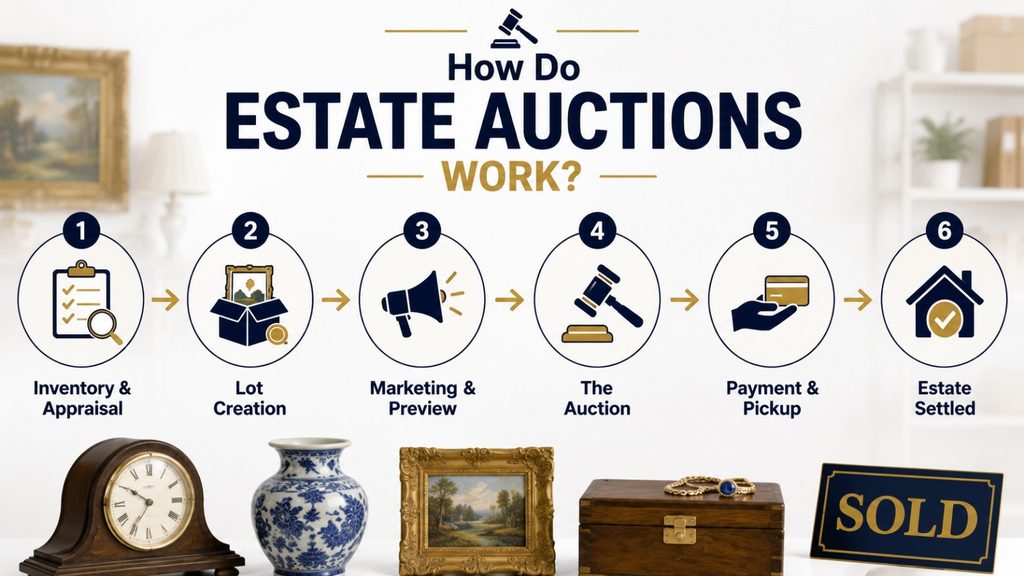
Step 1: Inventory and appraisal. The auctioneer walks through the house and catalogs everything. They photograph items, estimate values, and group related pieces together. This usually takes a few days and helps determine the sale date.
Step 2: Lot creation. Items are grouped into “lots” for bidding. A lot might be one item (a painting) or multiple items (a box of dishes). The auctioneer numbers each lot and creates a catalog or online listing.
Step 3: Marketing and preview. The auctioneer advertises the auction through their website, LiveAuctioneers, local papers, and email lists. They schedule a preview day (usually the day before the auction) so buyers can inspect items in person.
Step 4: The auction itself. On auction day, the auctioneer calls out lots one by one. Bidders raise their hands or place bids online. When no one bids higher, the auctioneer says “sold” and that lot is won by the highest bidder. A typical auction with 300 lots takes 4 to 6 hours.
Step 5: Payment and pickup. Winning bidders pay that day or within a few days (the auctioneer sets the deadline). Pickup happens on a set date, usually within a week. The buyer takes the item, the transaction closes, and the estate is settled.
First-hand detail: Auctioneers work fast. They call lots every 2 to 3 minutes. If you’re daydreaming, you’ll miss your item. This is why watching the first few lots before bidding matters. You learn the pace and the auctioneer’s style.
Catalog Lots. Take Bids. Get Paid.
Run your estate auctions online with lot catalogs, live and timed bidding, and automatic buyer’s premium and invoicing, all in one platform.

What gets sold at an estate auction?
Almost anything from a household can end up in an estate auction. Furniture, antiques, jewelry, tools, vehicles, art, collectibles, dishes, books, clothes, electronics, yard equipment.
Most items fall into three categories: furniture, collectibles, and everyday items.
Furniture moves first. Dining tables, chairs, dressers, bed frames, sofas. These are reliable bid-getters because people need them. A mid-century dining set might sell quickly. A set of wooden chairs in good shape will attract multiple bidders.
Collectibles attract specialists. People searching for vintage toys, coins, stamps, figurines, or rare books. These lots sometimes surprise everyone. A box of old Star Wars figures might go for $300. A signed first edition might go for $1,000. Collectors know what they want and they show up prepared to bid.
Everyday items fill out the sale. Dishes, cookware, linens, decorations, books, clothes, garden tools, yard equipment. These items rarely sell high, but they move fast. A box of vintage glassware might go for $20. Gardening tools might go for $15. These create volume and keep the auction moving.
The reality: You’ll find bargains in the everyday category. Most bidders focus on furniture and collectibles. That means a box of perfectly good kitchen gadgets might go for five dollars. A set of vintage cookware might sell for next to nothing. Smart buyers know this. They watch the items that others miss.
First-hand observation: Box lots are where bargains hide. An auctioneer might group 30 items into one lot to keep the auction moving. People either love the entire box or skip it. If the box contains some valuable pieces mixed with ordinary items, a smart bid gets you everything cheap.
Estate auction vs estate sale: what’s the difference?
People often confuse these two. They’re completely different things.
An estate auction sells the contents inside a home. Furniture, jewelry, collectibles, tools. The house itself stays on the market or is handled separately. You’re bidding on items, not property.
A real estate auction sells the actual house and land. The building, the foundation, everything attached to it. You’re bidding on the property itself. These happen when a bank forecloses, when a property needs to sell fast, or when an owner chooses this method.
The confusion matters because the stakes are different. Estate auctions are lower commitment. Real estate auctions require financing and inspections. Know which one you’re attending.
How to find estate auctions near you
Estate auctions happen constantly across the US, but they’re not always obvious. Here’s where to look.
LiveAuctioneers.com is the biggest. Search by location, filter by category, and see upcoming auctions nationwide. Most auctioneers post there. You can bid online or find local sale details.
Craigslist lists estate auctions in your area under the “for sale” section. Search “estate auction” and your city. Posts usually include date, time, preview hours, and the auctioneer’s contact.
Local auctioneer websites matter most. Google “estate auctioneer near me” and you’ll find companies in your region. They maintain their own auction calendars and email lists. Sign up for their newsletters to catch sales before they’re widely advertised.
Facebook groups for your area often share upcoming auctions. Search “[Your City] estate sales” or “[County] auctions.” Members post links and details regularly.
Estate liquidation companies like EstateSales.net advertise their events there too. Some specialize in your region.
The real advantage: local auctioneers have repeat buyers and established trust. They move inventory faster than national platforms. Start local first.
How to prepare for an estate auction
Walking into an auction unprepared costs you money. Here’s what actually works.

Set your budget first. Decide the maximum you’ll spend before you arrive. Auction energy is real. People bid higher in the moment than they planned. Write down your limit and stick to it.
Preview the items. Most auctions offer a preview day, usually the day before. Go. Handle the furniture. Check for damage, stains, or missing pieces. Read the lot descriptions carefully. Auctioneers note major flaws, but they don’t catch everything. A sofa might look fine from six feet away and have a rip underneath.
Research prices beforehand. Use Google Shopping, eBay sold listings, or Etsy to check what similar items sold for recently. A vintage lamp might be listed at $40 new but sold used for $12. Know the real market value before bidding.
Arrive early on auction day. Get there 30 to 45 minutes before start time. You’ll secure a good viewing spot, grab a bidding number, and watch the auctioneer’s rhythm on the first few lots. This matters. You learn how fast they move and how competitive bidders actually are.
Bring cash or a debit card. Some auctioneers accept credit cards with fees. Cash is safer. Have at least $500 available.
Bring a notepad. Write down lot numbers you’re targeting. When the auctioneer calls 200 lots in four hours, you’ll forget which one you wanted.
What you’ll actually pay: buyer’s premium and fees
The winning bid isn’t the final price. Hidden costs add up fast.
Buyer’s premium is the biggest one. It’s a percentage the auctioneer adds to your winning bid. Most charge 15% to 20%. If you win a lot for $100, you actually pay $115 to $120. Some auctioneers charge flat fees instead ($5 per lot). Always ask beforehand. It changes the math on everything you bid.
Sales tax applies in most states. That $100 lot at 15% premium becomes $115, then add sales tax (usually 7% to 10%). You’re now paying $123 to $127 for that $100 bid. Ignore this and you’ll overpay badly.
Pickup fees exist at some auctions. If the auctioneer handles shipping or storage, expect $25 to $100 depending on the item size. Large furniture might have a separate delivery charge.
Online bidding fees cost extra if you bid remotely. LiveAuctioneers charges roughly 3% to 5% on top of the buyer’s premium.
The reality: Your actual cost is often 25% to 35% higher than the winning bid. A $100 item becomes $125 to $135. Factor this into your budget before you bid. It’s the most common mistake first-time buyers make.
Tips for buying well at an estate auction
Smart bidding separates bargain hunters from money wasters.
Start small. Bid on one or two items in your first auction. Watch how prices move. See which lots attract competition. Don’t go in swinging on everything.
Target the overlooked stuff. While everyone fights over the antique dresser, box lots of kitchen tools sit empty. A box of perfectly good pots, pans, and utensils might sell for $10. That’s where real value hides.
Know when to walk away. If two collectors are bidding against each other on a vintage toy, the price climbs fast. Let them have it. There’s another lot in five minutes.
Bid strategically, not emotionally. Decide your max price for each lot before the auctioneer calls it. Stick to that number. Auction adrenaline makes people bid 40% higher than they planned.
Check condition carefully at preview. A chair with one wobbly leg is worth half what a solid chair is worth. A lamp with a broken shade costs you time and money to fix. Don’t assume “it’ll be fine.” It won’t.
Buy furniture in good condition. Damaged furniture sells cheap for a reason. Repairing upholstery costs $300 to $800. A loose leg needs woodwork. Stains don’t always come out. Buy solid or skip it.
Understand lot groupings. If five items are grouped into one lot, you buy all five or nothing. Sometimes that works in your favor. Sometimes you’re paying for three things you don’t want to get the one you do.
Network with other buyers. Talk to the people around you. Regular auction attendees know which auctioneers run tight sales, which ones overestimate value, and where the real deals hide. They’ll tell you.


Nitesh Singh is a software veteran and the Founder of Ultimate Auction. With 16+ years of experience in web development, he specializes in building high-performance auction tools for the WordPress community. Connect with Nitesh on LinkedIn or follow his latest auction strategy guides here.
More articles by Nitesh SinghRelated Post

15 Must-Have Features in Auction Software (Checklist)
Picking auction software gets easier once you know which 15 features matter and which ones just pad a pricing page. This checklist is for auction house owners, ecommerce teams, and startups choosing a platform. It covers everything from real-time bidding to fraud protection. After reviewing [PLACEHOLDER: number] auction platforms, here’s what separated the good ones […]
Read More
How Much Do Estate Auctioneers Charge
Estate auctioneers typically charge 15-35% commission on what your items sell for. But the actual cost depends on what’s included, where you are, and what you’re selling. Understanding these fees upfront helps you compare auctioneers fairly and know what you’ll actually take home. How Much Will You Actually Pay? Estate auctioneers charge in several ways. […]
Read More
Online Auction Software: What to Look for Before You Buy
Switching auction platforms after a bad launch costs far more than choosing well the first time. This guide is for auction houses, nonprofits, and resellers choosing online auction software. You’ll leave with a feature checklist, a way to compare fees, and a list of questions to ask on every demo call. Online auction software is […]
Read More